Is sewage backing up into my house a septic problem?
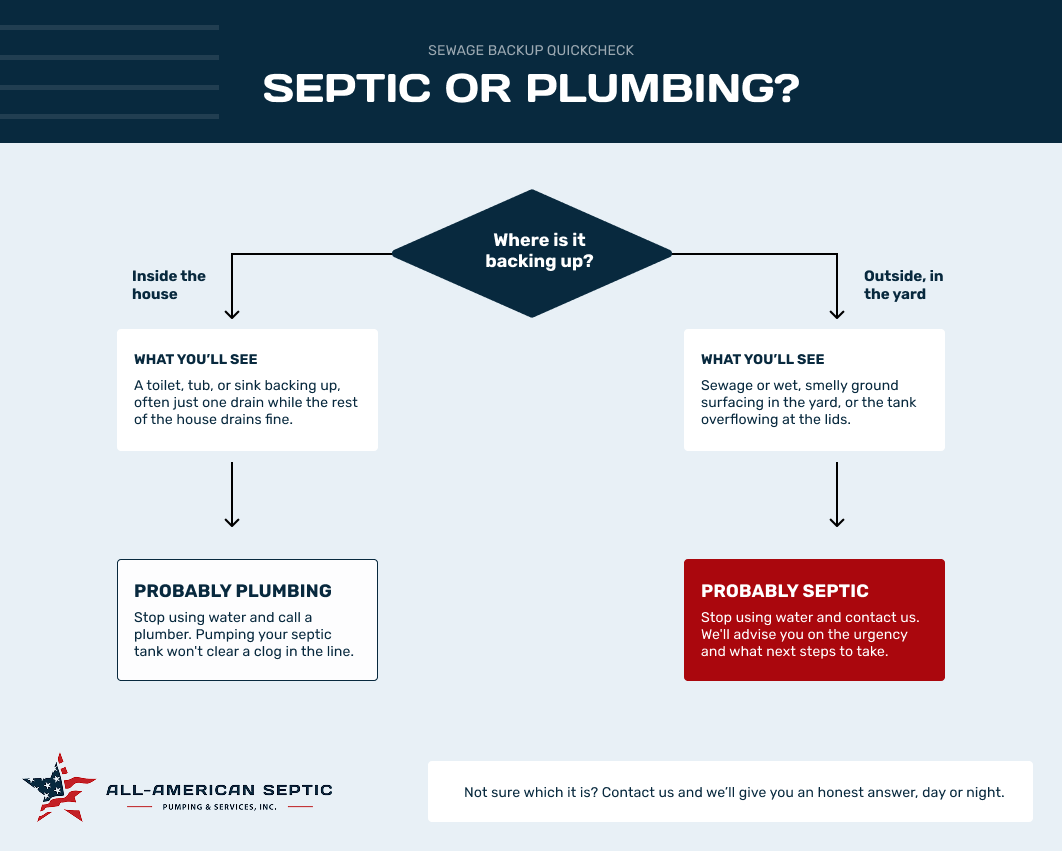
Most of the time, no. When a San Diego homeowner texts us about a “septic emergency,” our first question is always the same: is it backing up into the house? If it is, that almost always points to the plumbing, not the tank.
Wastewater has to travel through your home’s drain lines before it ever reaches the septic tank. If something blocks that path, the water has nowhere to go but back up through your drains.
Wipes, grease, or buildup in the line are common culprits. Your tank can be working exactly the way it should, even if your bathroom floor says there’s a problem. (And there is, but it’s probably not your septic tank.)
Note: A severely overdue septic tank or a failing drain field can occasionally push water back into the house. It’s possible but rare. We stand by the general rule that sewage backing up into the house is almost always a plumbing issue.
How can I tell if it’s my plumbing or my septic tank?
Start by noticing where the problem shows up. Trouble inside the house usually means plumbing. Trouble outside, around the tank or drain field, is more likely septic.
Signs that point to your plumbing:
- One toilet, tub, or sink backs up while the rest of the house drains normally.
- The backup started after something went down a drain that shouldn’t have.
Signs that point to your septic system:
- Sewage or wet, smelly ground surfacing in your yard.
- Your septic tank is overflowing at the lids.
If you’re not sure,
text or call us at (760) 410-6549. We’ll ask a couple of quick questions and tell you straight whether it sounds like a job for us or for a plumber.
What should I do right now?
Stop using water, then call a plumber. (Or call us, and we’ll advise you.)
Every flush, shower, and load of laundry adds to the backup, so shut it down until the line is cleared. If it’s the middle of the night, it can usually wait until morning. Calling at 2 a.m. often means paying an after-hours premium for something that would cost less, and be handled just as well, once the sun comes up.
We know how stressful a backup feels in the moment. We deal with this every week, and it’s rarely as big a deal as it seems at 2 a.m.
Will pumping my septic tank fix a backup?
Not if the cause is a clog. Pumping empties your tank, but it won’t clear a blockage in the line between your house and the tank.
If you’d still like your home’s septic tank pumped, we’ll come out. If it’s a clog, we’ll tell you up front that pumping won’t fix it. We’d rather send you to the right person than charge you for a service that doesn’t solve your problem.
It also helps to know that a septic tank is designed to sit full all the time (one of the septic myths we see most often!). Seeing liquid at the top when you lift a lid doesn’t mean the tank is causing your backup.
What actually counts as a septic emergency?
A true septic emergency usually happens outside: sewage surfacing in your yard, or a tank overflowing at the lids.
If that’s what you’re seeing, stop using water and contact us. We’ll get out to you as soon as we can.
Learn more on our Emergency Septic Services page.
Why would my plumber say it’s my septic?
Septic systems are a specialty, and not every plumber works with them regularly. That isn’t a knock on plumbers. It’s just a different trade.
If your plumber thinks the septic is involved, we’re happy to talk it through with them directly. Plumbers with septic questions are always welcome to call us at (760) 410-6549.