Do I need to add Rid-X or another septic treatment?
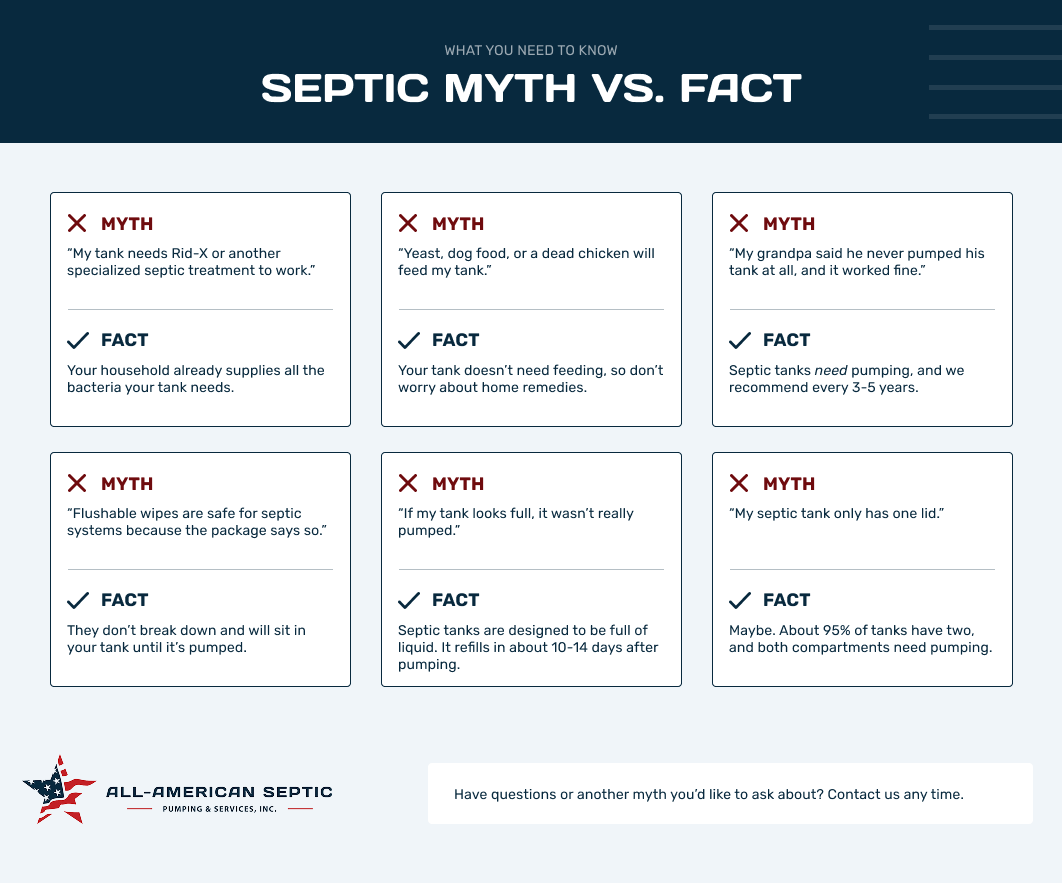
No. A household septic tank doesn’t need additives to work.
The bacteria that break down waste in your tank come from the waste itself. Every flush keeps the tank supplied. That’s how septic systems were designed to work, and they’ve done it for a long time without help from a box or a bottle.
What an additive can’t do is replace regular septic pumping. Some solids never break down, no matter what you put in the tank, and the only way to get them out is to pump them out.
Should I put yeast, dog food, or a dead chicken in my septic tank?
No, no, and no. We hear all three, along with plenty of other folk remedies passed down from relatives or picked up online. The idea is usually that you need to “feed” your tank or “start” its bacteria. You don’t. Your household waste already handles that perfectly well.
The most common version we hear goes something like: “My neighbor puts dog food in his tank, and he’s never had to pump it.” Never having pumped doesn’t mean he shouldn’t have. It means the problem hasn’t caught up with him yet.
My grandpa never pumped his septic tank. Do I really need to?
Yes. A tank can go years without showing any sign of trouble, but that doesn’t mean it isn’t filling up.
Solids build up over time, and by the time a neglected tank causes a visible problem, the fix is usually bigger and more expensive than routine pumping would have been. The same goes for being told you can wait 10 years between pumps.
Our recommendation: most homes need pumping every 3–5 years.
Are flushable wipes safe for septic systems?
No. Just because something can be flushed doesn’t mean it belongs in your septic tank.
Flushable wipes don’t break down the way toilet paper does. They sit in your tank until a pumper removes them, and a tank full of wipes takes more work to pump. Toss them in the trash instead.
My tank looks full again. Did it actually get pumped?
Almost certainly yes, if you’re looking at liquid. A working septic tank is supposed to sit full of liquid all the time.
After pumping, the liquid level comes back up within about 10–14 days for an average household. If you lift a lid a month later and see a full tank, that’s normal. Pumping is about removing the sludge and scum that build up over time, not leaving the tank empty.
That said, a proper pump empties every compartment of the tank. That’s why the next myth matters.
Does my septic tank only have one lid?
Probably not. About 95% of the tanks we pump have two lids.
We’ve only seen a handful of single-lid tanks, all of them very old. If your home was built in the last several decades and you’ve only found one lid, there’s very likely a second one nearby. Both compartments need to be pumped for the job to be done right, so make sure we can get to both lids.
Will pumping my septic tank fix a backup in my house?
Usually not. Sewage backing up into your house is most often a plumbing clog, and pumping your tank won’t clear it.
If you’re dealing with a backup right now, start here: Sewage Backing Up Into Your House? It’s Probably Not Your Septic.