How often should I pump my septic tank?
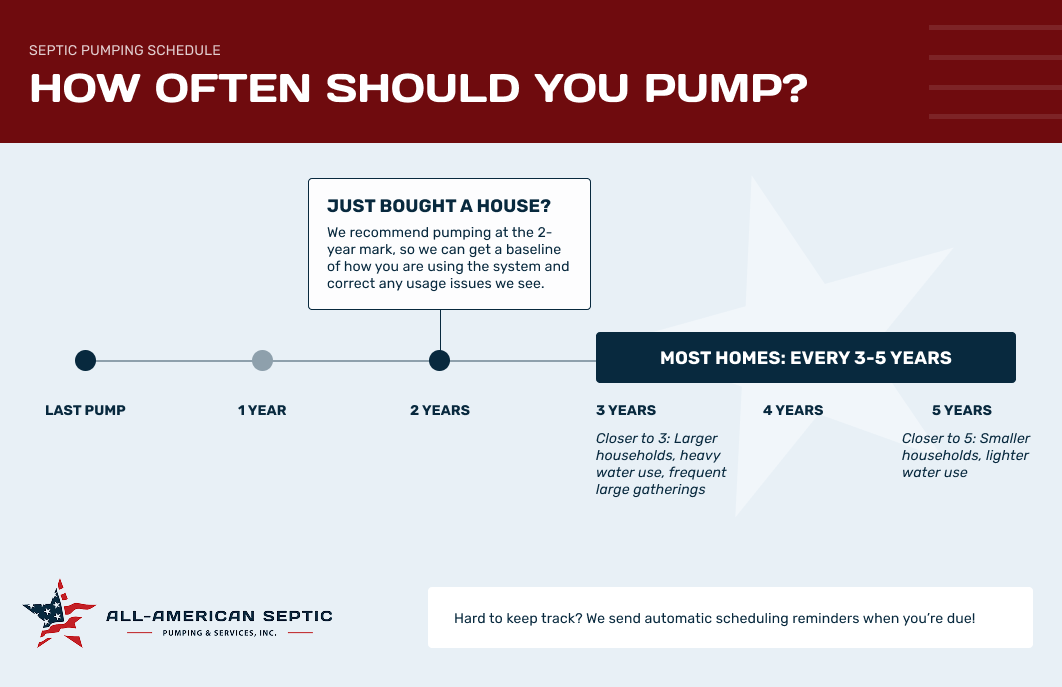
Every 3–5 years for most households.
That’s the range we give most homeowners in San Diego County, and it holds for an average house with an average family and an average-sized tank.
The trouble is that not every home is average. If your household is bigger than most, uses a lot of water, or hosts a lot of guests, you’ll be closer to 3 years. A smaller household that’s easy on its system can stretch toward 5.
If you’re unsure, ask us when we pump. We’ll tell you what we see in your tank and when we’d plan to come back. (We even offer automated text reminders for septic pumping!)
I just bought a house. When should I pump?
Plan on pumping within 2 years of buying, even if the system seems fine. You have no way of knowing when the last owners pumped it, what went down their drains, or whether they ever pumped it at all.
If you’re still in escrow, your lender may require a septic inspection. All-cash offers often skip it, but you still should get one. It’s the best chance to learn where your tank is and what shape it’s in before it becomes your problem.
What changes how often my septic tank needs pumping?
The biggest factors are how many people live in the home, how large your tank is, and how much water and waste go into it.
A few things can move you up the schedule:
- A bigger household or more full-time residents than the tank was sized for.
- Big gatherings. If you’re hosting a large party, consider pumping before or after it, so you aren’t putting that extra load on a tank that’s already due.
- Flushable wipes. Despite what they may say, most “flushable” items will sit in your tank until it’s pumped. They do not break down effectively.
What’s different about septic in San Diego County?
Many homes in the county have little or no paperwork on their septic system, and tanks aren’t always where you’d expect.
Septic permits weren’t required in the county until 1978. Many older homes have nothing on file at all. Newer homes have plans, but tanks sometimes got moved during installation. A big rock in the way could shift the tank several feet from where the plans show it. On larger rural properties across San Diego County, the tank could be almost anywhere.
That’s why, upon request, we pull county records for our customers as a complimentary service with our residential septic pumping. Records aren’t always accurate, but they’re the best place to start.
A few more things that surprise homeowners here:
- Most tanks have two lids. About 95% of the tanks we see do, even when homeowners are sure theirs only has one.
- Most homeowners dig up their own lids before we arrive. If yours are buried deep or you’d rather not dig, ask us about riser installation, which brings the lids up to ground level for every future pump.
- We don’t put the dirt back after we pump, so plan to fill the hole back in yourself.
Why does my tank look full right after it was pumped?
Because septic tanks are supposed to be full. A working tank sits full of liquid all the time. What pumping removes is the built-up sludge and scum that the tank can’t break down on its own.
For an average household, the liquid level comes back up within 10–14 days of pumping. If you lift a lid a month later and see a full tank, that’s normal, and it doesn’t mean the tank wasn’t pumped.
Is regular septic pumping worth the cost?
Yes. Averaged out, pumping every few years works out to roughly $12 a month. (Compare that to city sewer customers who typically pay $50–60 a month.)
Skipping pumping doesn’t save that money, either. Solids that build up past the tank’s limit can push into your drain field, which turns into a much bigger repair than a routine septic pump.